
We used to hear of the Modi-Shah pair as the hyphenated top of the BJP leadership. Lately, the hyphen has disappeared and it is only Modi at the top. Yogi Adityanath gets honourable mentions, but he is still a good distance away from being anointed a worthy successor, observes Shreekant Sambrani.

This visit has ended on a vastly different note in comparison with Modi's previous visits. Call it a rebuke, call it a censure, call it a distancing from Modi, the sharp message would have gone home, observes Ambassador M K Bhadrakumar.
The Bharatiya Janata Party and other right-wing outfits had strongly objected to the paintings which had portrayed the trishul, a symbol of Hinduism and 'Bharat Mata', in an inappropriate manner.

'Maybe the BJP believes, in the post-poll scenario, it will have the might to foist, anybody endorsed by the RSS, upon Bihar,' observes Mohammad Sajjad.

'The immediate attempt by China is to get its way and gain territory through small steps without having a full-scale war.'

Only Bong Joon Ho -- whose film Parasite won the Oscars for Best Film, Best Director, Best International Feature -- knows how to work with a heavy hand and still get respectable results, says Ranjita Ganesan.

'After the Congress's 2014 Lok Sabha debacle, commentators identified three major shortcomings: Leadership, organisation, and ideology.' 'Here we are six years later -- and what are the Congress's major failings? Leadership, organisation, and ideology.' 'The party seems to have learned very little during its six years in the Opposition wilderness.'

Asking the people of Bihar to bring their own government to power, the post made a veiled reference to the alleged high handedness of bureaucracy under the JD(U)-BJP rule but fell shy of a frontal attack on Chief Minister Nitish Kumar, his arch rival, or the near hegemonic saffron party which considers him a bete noire.

Here is a look at Kumar's previous statements, made after he quit the NDA alliance, which proves the adage: there are no permanent friends and enemies in politics.

Neither Biden nor his successors can any longer ignore the threat China has come to pose to the US in both economic and military fields, observes Virendra Kapoor.

We can expect to see more Chinese wolf warrior diplomats on the prowl, in India's neighbourhood, though its mailed fist is not so visible while dealing with India, observes Colonel R Hariharan (retd).
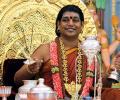
'It's a moot point if Kailaasa will ever evolve beyond being a haven for a fugitive from justice,' notes Devangshu Datta.

Known for weighing his options carefully before making any move, Kumar, upon a closer look, comes across as a risk taker who has not shied away from going against the tide.

In the test, a space rocket boosted a hypersonic glide vehicle, one capable of carrying a nuclear device, which circled the globe before impacting.
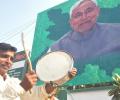
Known for weighing his options carefully before making any move, Kumar, upon a closer look, comes across as a risk taker who has not shied away from going against the tide.

With the situation in Ladakh tense and no resolution in sight the trigger to take the India-US relationship to a transformational one is already there, observes Lieutenant General Syed Ata Hasnain (retd).
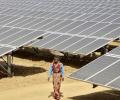
Arunabha Ghosh on why India will increasingly become an energy great power, but not an energy hegemon.

'China wants to change the status quo of India's Northern Border and proves that it can do whatever it wants in what it perceives as its own territory,' states Claude Arpi.

The Emergency greatly influenced the RSS' makeover from a fringe force in the Indian political imagination to one that could have its own man sworn in as prime minister in two decades' time. A riveting excerpt from Christophe Jaffrelot and Pratinav Anil's India's First Dictatorship: The Emergency, 1975-1977.

An aggressive Pyongyang is likely to force Seoul and Tokyo to build nuclear deterrents and thus thwart Beijing's ambitions.

Many leaders from non-Hindi states, especially Tamil Nadu and Karnataka, had opposed the policy.

Makarand Paranjape, poet and professor of English at Jawaharlal Nehru University on Monday took on students union president Kanhaiya Kumar who is facing sedition charge, asking him whether he checked his facts before delivering the much-celebrated speech.

The development came a day after the protesting farmers rejected the Centre's offer to start talks as soon as they move to Burari and continued to stay put Singhu and Tikri borders of the national capital.
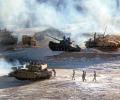
India's national security strategy needs to be revised periodically since the global and regional geopolitical situation is dynamic, points out Commodore Venugopal Menon (retd).
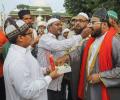
'For Muslims, India is now a Hindu Rashtra, no matter what kind of Constitution is still in place,' argues Mohammad Sajjad.
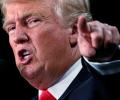
'If there is one certainty in this visit, it is that Trump does not follow a script. He is unpredictable,' highlights Ambassador B S Prakash.
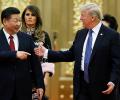
'We have here the world's largest economy and dominant superpower thrashing about as it wrestles with its own decline.' 'It has become everything that China was supposed to be: A threat to the world order, and as a country that is not playing by the rules on trade, on climate change, international commitments and nuclear deals,' says T N Ninan.

The India-Japan joint naval exercises are a strategic signal for China, observes Dr Rajaram Panda.

'There are reports of political dissent mounting on Xi Jinping's handling of the Wuhan fallout.'
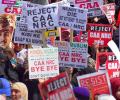
'How many Indian parents, still alive, really have documents of, their parents's date and place of birth? Not more than 27% of still alive Indians have got birth certificates,' points out Mohammad Sajjad.

'In Kairana, the grand coalition was able to transfer its votes to a Muslim candidate in supposedly an era of anti-Muslim ambience.' 'Given this perspective, the Kairana result seems more significant than that of Gorakhpur and Phulpur a few months ago,' says Mohammad Sajjad.

'India in 2020 is a lot better prepared than in 1962.' 'It is no longer a pushover; and anything other than a crushing Chinese military victory will be a major loss of face for China,' observes Rajeev Srinivasan in the first of a three part column.
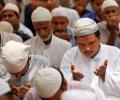
'This time, even the professedly secular parties have maintained a conscious distance from being identified with Muslims.' 'This could be interpreted as a success of the BJP campaign of what it has been calling 'minority appeasement', says Mohammad Sajjad.
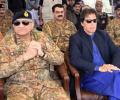
'Any conventional conflict could trigger a nuclear war with results that neither India nor Pakistan could survive easily.' >A revealing excerpt from Shuja Nawaz's The Battle For Pakistan: The Bitter US Friendship And A Tough Neighbourhood.

'Nehru's hegemonic politics has been responsible for many ills, which undoubtedly includes Kashmir'
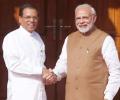
'Modi's first foreign trip at the very outset of his second term as PM reinforces a growing impression that this regional tour underscores a shift in emphasis in India's foreign policy that was traditionally focused on the northern tier of countries to the Indian Ocean rim,' explains Ambassador M K Bhadrakumar.

'Ambedkar's ideas have their own teeth -- if you don't have an appetite for them, you can't swallow them.'

'In the name of pluralism-secularism, the kind of politics that was pursued revealed to many that it was basically a favour to Muslim conservatism and communalism -- a politics of minority-ism, rather than of secularism.' 'This is how significant sections of Hindus have been made to loathe the very idea of Indian secularism by now,' says Mohammad Sajjad.

All the fixes require either the enactment of a data-protection law, or the amendment of our existing competition law. This can take many years. However, there is an opportunity for the government to act immediately if it wishes to, says Sunil Abraham.

The American oceanographic survey ship which controls the underwater drone seized by China had been spying against the Communist nation posing a threat to Chinese naval ships in the South China Sea, a state-run daily has said while claiming that such activities by the US Navy were "very rampant" in the strategic region.
